Cancer is the second leading cause of death in the United States, claiming nearly 575,000 lives a year. Those deaths are the result of over 200 types of cancer, some of which remain only partially understood. But thanks to research, this gap between what we do and do not understand about cancer is shrinking.
We continue to take significant strides in how we treat cancer, and Drexel University College of Medicine is proud to contribute to that advancement by educating future researchers through our Cancer Biology (CBIO) program.
The Cancer Biology program is one of the most unusual programs in the country, as it offers students ability to work alongside 35 top cancer researchers in the Philadelphia area, including scientists from top cancer institutions including Drexel University, The Wistar Institute, Fox Chase Cancer Center and Lankenau Institute for Medical Research.
The program provides a master's degree focused on the fundamentals of cancer from an interdisciplinary perspective, including molecular and cell biology of cancer initiation, metastasis, immunology, treatment and prevention while gaining experience in cutting edge technology. Graduates of the program gain comprehensive knowledge of molecular, cell and cancer biology, as well as expertise in the latest techniques used in cancer biology research.
Is Cancer Biology for Me?
The Cancer Biology program is designed for students who wish to pursue a career in basic and applied cancer research, leading them to investigate the molecules, mechanisms, and pathways involved in the development of this disease.
Students in the program come from many backgrounds including:
- New college graduates
- Recent college graduates interested in career changes
- Laboratory technicians
- Industrial and biotechnology employees
There are also available online master of science and post-bacc certificate programs in Molecular Basis of Cancer.
Meet a Student/Alum
Rusia H. Lee, Cancer Biology Program Class of 2018
"What is for sure is that if you're open to it, you will learn everything from the tangible skills, like the biochemical assays and the actual benchwork, to the intangible skills, like lab etiquette and how to present data to your team/boss. No matter where you go in science, these are the skills that are highly sought after." Read more.
Rebecca Moeller, Cancer Biology Program Class of 2020
"I had a really great relationship with the faculty — not only were they always accommodating and willing to answer questions, but they genuinely care about the success of their students. I had the privilege to do my first lab rotation at the Wistar Institute, and even there I was warmly welcomed and given every opportunity I could grasp. I’m a very independent scientist, and faculty were always able to guide me while accommodating my desire to really spearhead my own project. It was a very personalized experience."
Read more.
News & Announcements
MCBG/Cancer Bio Graduate Programs Seminar Series Fall 2023
- Every Thursday at 1 p.m.
- Some external speakers will be Zoom only. All others hybrid (in person & Zoom).
- Zoom available only for students working in Queen Lane, Fox Chase or Wistar. If working in New College Building you MUST attend in person.
- In person seminars will be held in New College Building, Geary A Auditorium
- All students must attend seminar. Only allowed to miss three seminars per year.
- Contact Eishi Noguchi, PhD at en34@drexel.edu for meeting ID and password.
Learn more about the Fall 2023 Seminar Series.
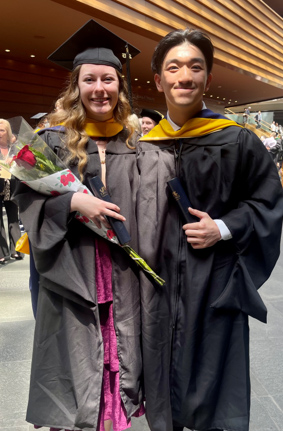
Congratulations 2023 Graduates
Congratulations to Jennifer Lynch and Justin Do, 2023 graduates of the Cancer Biology program. Jennifer completed her MS thesis in the lab of Dr. Alessandro Fatatis and Justin in the lab of Dr. Christian Sell.
Congratulations 2022 Graduates
Congratulations to Dalal Hassan, Pritika Shahani and Samuel Evans, 2022 graduates of the Cancer Biology program. Dalal completed her non-thesis MS in the lab of Dr. Alfonso Bellacosa, Pritika completed her MS thesis in the lab of Dr. Michael Bouchard and Samuel in the lab of Dr. Sri Somarowthu.
Alumni Publication in Frontiers in Molecular Biosciences
MS Cancer Biology graduate Fatimah Alfaran (2020) is co-author on a recent publication entitled "Copper Modulates the Catalytic Activity of Protein Kinase CK2” in the June 2022 issue of Frontiers in Molecular Biosciences. Fatimah performed her MS thesis research in lab of Dr. Todd Strochlic.
Congratulations to Pritika Shahani, MS candidate in our Cancer Biology program working in lab of Dr. Michael Bouchard, who will be starting a PhD program in at Medical University of South Carolina in Fall 2022.
Congratulations to Samuel Evans, MS candidate in our Cancer Biology program working in lab of Dr. Sri Somarowthu, who will be attending the PhD program in Genetics, Genomics, and Cancer Biology at Thomas Jefferson University in Fall 2022.
Read More News
In the Media
"Teaming Up to Fight Brain Tumors"
College of Medicine Alumni Magazine (Fall/Winter 2016)