Pharmacology examines and characterizes the action of drugs in humans and animals. It emphasizes the therapeutic responses of drugs, their mechanisms of action, the fate of drugs in the body, potential adverse reactions, and drug-drug interactions. Physiology considers processes that control and regulate the functioning of systems within an intact organism.
Basic physiological processes underlie all fields in biomedical science. Understanding and exploiting the specific actions of drugs can also furnish a way to probe physiological and biochemical processes in both normal and pathological circumstances. Research in pharmacology and physiology provides challenging and exciting opportunities for graduate study.
The Pharmacology and Physiology (PHPH) program offers graduate courses leading to the MS and the PhD. Both degrees require independent research under the direction of faculty members in the department, who are engaged in highly active research programs involving molecular, cellular and behavioral approaches to experimental pharmacology and physiology in a strongly collaborative environment.
Learn more about the curriculum and program requirements
Our Students and Alumni
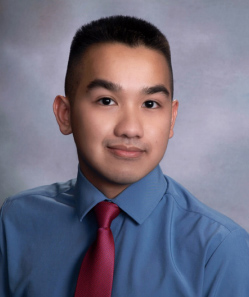
"I moved here to the United States from Vietnam when I was a 10-year-old. I got my undergraduate degree in health sciences from Drexel. During that time, I became interested in pharmacology and physiology because I lost my dad to cancer. He was on so many treatments like chemotherapy, and it made me interested to find out what he was taking. I had wanted to go to medical school, but my perspective changed after I saw how his treatment went." Read more.
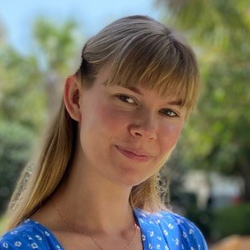
"My initial interest in the Pharmacology and Physiology Department was partly due to their involvement in the Drug Discovery and Development program. I had always wanted to go into biopharma, and the opportunity to take classes in drug discovery was exciting to me. Additionally, a big draw for me was the work that Dr. Ole Mortensen was doing, and after meeting him I knew I wanted to work in his lab." Read more.
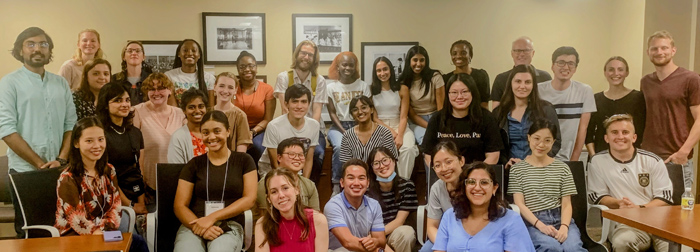
Welcome to Our First-Year Students
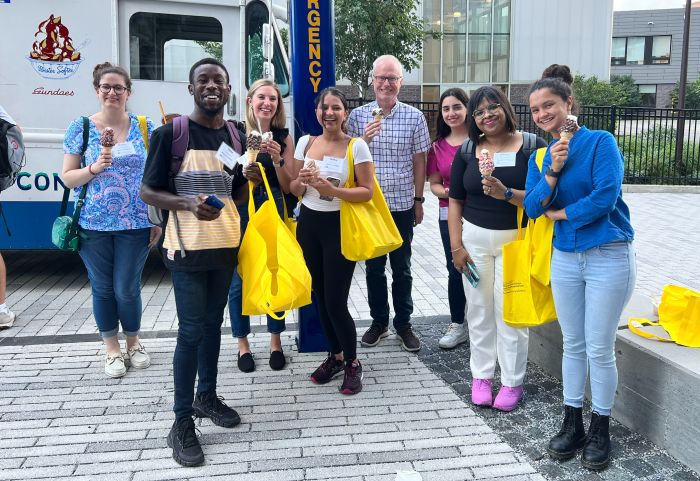
Left to right: Thalia Dimopoulos (PhD), Isaac Turkson (PhD), Elizabeth Homer (PhD), Nitika Gupta (PhD), Ole Mortensen, PhD (program director), Melina Kazemi (MS), Adrika Mondal (MS) and Aarohee Bhattarai (PhD)
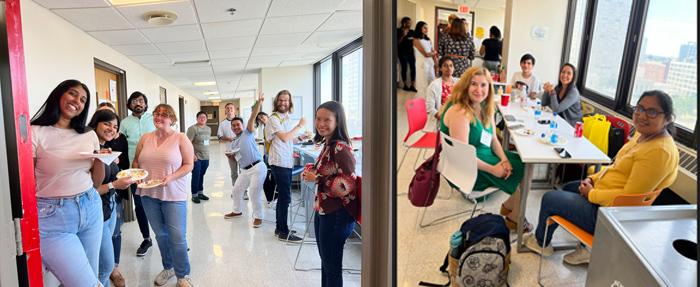
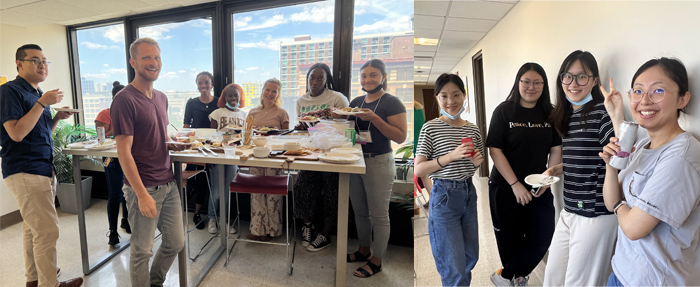
Summer Potluck
The Pharmacology & Physiology graduate students held a potluck to celebrate the return to the lab this summer.
Student Achievements
Dean’s Travel Award
Congratulations to Deepa Reddy, recipient of the Dean’s Travel Award for the spring 2024 award cycle. Reddy is a PhD candidate in the Pharmacology & Physiology program. The Dean’s Travel Award is meant to partially defray the cost of attending a scientific meeting at which a graduate student is making a presentation, that is related to the student’s graduate study.
View Photos
Recent Student Awards
Congratulations to the following awardees at the annual Department of Pharmacology and Physiology retreat:
- Ben Weiss Scholar Award: Xuan Luo (Ajit lab)
- Chair’s Awards: *For unique achievements in research and service* Katelyn Reeb (A. Mortensen lab) and Jason Wickman (Ajit lab)
- Mary Hoffman Shaw Travel Awards: Qiaowei Xie (Barker lab) and Ruxu Zhai (Fatatis lab)
Dean’s Travel Awards
Congratulations to Breana Channer (Gaskill lab) and Qiaowei Xie (Barker lab) for earning Dean’s Graduate Student Travel Awards! These awards are provided by Drexel’s Graduate School of Biomedical Sciences and Professional Studies to support trainees attending a scientific meeting.
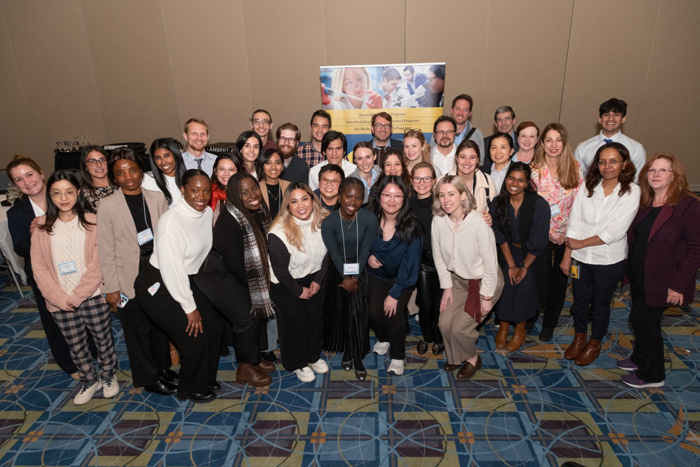
Discovery Day 2023
Congratulations to Bondi Fellowship recipient Xuan Luo and Outstanding Senior Graduate Student Poster 1st Place winner Katelyn Reeb for her project "EAATs for stroke: to modulate or not to modulate." View Discovery Day 2023 photo gallery.
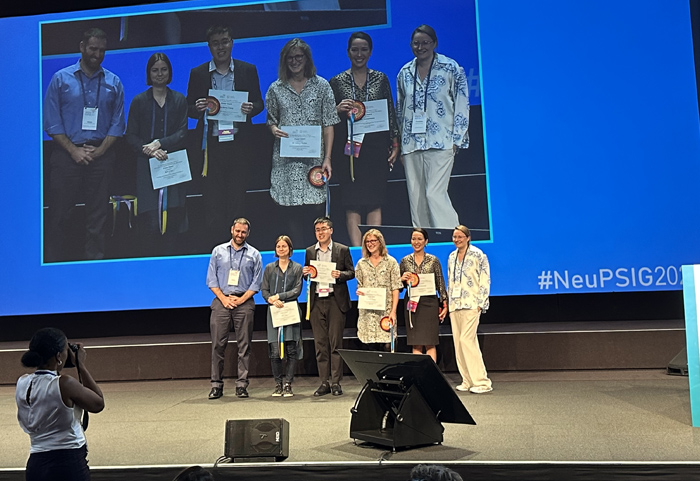
Congratulations to Rhea Temmermand
Rhea (mentored by Andreia Mortensen) won the Best Poster Award at the International Congress on Neuropathic Pain (NeuPSIG2023) in Lisbon, Portugal on September 5-9, 2023.
Drexel Emerging Graduate Scholars Conference Award
Katelyn Reeb won the Dean’s Award for Best Research Poster Presentation at the 2023 Drexel Emerging Graduate Scholars Conference. Katelyn’s award-winning poster was titled “Positive allosteric modulation of glutamate transporter EAAT2 as a novel therapeutic approach for neurological disorders.”
Dean’s Travel Award
Congratulations to Jason Wickman (mentored by Seena Ajit), winner of the Dean’s Travel Award. The Dean’s Travel Award is meant to partially defray the cost of attending a scientific meeting at which a graduate student is making a presentation, or is related to the student’s graduate study.
Congratulations Katelyn Reeb
Katelyn Reeb won second prize for her poster presentation at the annual meeting of the Philadelphia chapter of the Society for Neuroscience (PCSFN).
Congratulations Deepa Reddy
Deepa Reddy won honorable mention in the category of Brain and Behavior for her poster presentation at the AAAS 2023 Student E-poster Competition.
PhRMA Foundation Predoctoral Fellowship in Drug Discovery
Congratulations to Katelyn Reeb (mentored by Andreia Mortensen) for being awarded the PhRMA Foundation pre-doctoral fellowship (phrmafoundation.org/awards/past-award-recipients/2023-award-recipients) on her project entitled "Positive Allosteric Modulation of EAAT2 for the Treatment of Neurological Disorders."
Read more student achievements.
"Responsible Genes for Neuronal Migration in the Chromosome 17p13.3: Beyond Pafah1b1(Lis1), Crk and Ywhae(14-3-3ε)"
Xiaonan Liu, Sarah A. Bennison, Lozen Robinson, Kazuhito Toyo-Oka
Brain Sci. 2022, 12, 56
"Mechanisms of neuronal dysfunction in HIV-associated neurocognitive disorders"
Irollo E, Luchetta J, Ho C, Nash B, Meucci O
Cell Mol Life Sci. 2021 May;78(9):4283-4303
"Human mini brains and spinal cords in a dish: Modeling strategies, current challenges, and prospective advances"
Kofman, S., Mohan, N., Sun, X., Ibric, L., Piermarini, E., Qiang, L.
Journal of tissue engineering, 13, 20417314221113391. (2022)
"Double life: How GRK2 and β-arrestin signaling participate in diseases"
Zhai R, Snyder J, Montgomery S, Sato PY
Cell Signal. 2022 Jun;94:110333
"Myocardial GRK2 Reduces Fatty Acid Metabolism and β-Adrenergic Receptor-Mediated Mitochondrial Responses"
Zhai R, Varner EL, Rao A, Karhadkar S, Di Carlo A, Snyder NW, Sato PY
Int J Mol Sci. 2022 Mar 3;23(5):2777
"Subsets of cancer cells expressing CX3CR1 are endowed with metastasis-initiating properties and resistance to chemotherapy"
DiNatale, A., Kaur, R., Qian, C., Zhang, J., Marchioli, M., Ipe, D., Castelli, M., McNair, C. M., Kumar, G., Meucci, O., Fatatis, A.
Oncogene, 41(9), 1337–1351. (2022)
"Co-receptor signaling in the pathogenesis of neuroHIV"
Nickoloff-Bybel EA, Festa L, Meucci O, Gaskill PJ
Retrovirology. 2021 Aug 24;18(1):24
"Circulating microRNAs from the mouse tibia fracture model reflect the signature from patients with complex regional pain syndrome"
Wickman JR, Luo X, Li W, Jean-Toussaint R, Sahbaie P, Sacan A, Clark JD, Ajit SK
Pain Rep. 2021 Aug 24;6(3):e950
"Therapeutic Strategies for Mutant SPAST-Based Hereditary Spastic Paraplegia"
Mohan, N., Qiang, L., Morfini, G., Baas, P. W.
Brain sciences, 11(8), 1081. (2021)